EN 166 is the European standard for personal eye protection, used in the UK for safety spectacles, goggles and face shields. Every compliant product carries two short codes: one on the lens and one on the frame. Together they tell you how clear the lens is, how much impact it can take, and which hazards the product is designed for.
Lens and frame are marked separately
- Lens: filter code and shade (if it is a filter), the maker’s mark, the optical class, the impact grade, then any extra marks such as K, N, 8 or 9.
- Frame: the maker’s mark, EN 166, the hazard codes it is designed for (3, 4, 5, 8, 9) and the impact grade.
- Where the lens and frame carry different impact grades, the lower one applies to the whole product.
| Class | Meaning |
|---|---|
| 1 | Best optical quality, suitable for continuous all-day wear |
| 2 | Intermediate work |
| 3 | Occasional use only, not for prolonged wear |
| Mark | Test | Can be carried by |
|---|---|---|
| S | Increased robustness (22 mm steel ball at about 5 m/s) | Spectacles, goggles, face shields |
| F | Low-energy impact: 6 mm particle at 45 m/s | Spectacles, goggles, face shields |
| B | Medium-energy impact: 120 m/s | Goggles and face shields only |
| A | High-energy impact: 190 m/s | Face shields only |
A T after the impact grade (FT, BT, AT) means the impact test was also passed at extreme temperatures, from −5 °C to +55 °C. Choose T-marked eye protection for cold stores, outdoor winter work and hot environments.
| Code | Protects against | Typically found on |
|---|---|---|
| 3 | Liquid droplets or splashes | Goggles (droplets), face shields (splashes) |
| 4 | Large dust particles (over 5 microns) | Goggles |
| 5 | Gas and fine dust (under 5 microns) | Sealed goggles |
| 8 | Short-circuit electric arc | Face shields |
| 9 | Molten metal and hot solids | Goggles and face shields |
Filter codes and coating marks
- Filter codes come first on a lens, with a shade number after the dash: 2 is a UV filter (EN 170), 2C or 3 is UV with good colour recognition, 4 is infrared (EN 171) and 5 or 6 is sunglare (EN 172). Clear lenses are usually shade 1.2.
- K: resistant to surface damage by fine particles (anti-scratch).
- N: resistant to fogging (anti-fog).
- Welding filters follow EN 169 and welding shields EN 175, and are marked with their own shade numbers.
A worked example
A lens marked 2C-1.2 [maker] 1 FT KN is a clear UV filter with good colour recognition (2C-1.2), optical class 1, rated for low-energy impact including at extreme temperatures (FT), with anti-scratch and anti-fog coatings (KN). If its frame reads [maker] EN 166 3 4 BT, the product also protects against liquid droplets (3) and large dust (4), and the frame takes medium-energy impact — but the product as a whole is only rated F, because the lower grade applies.
Choosing by job
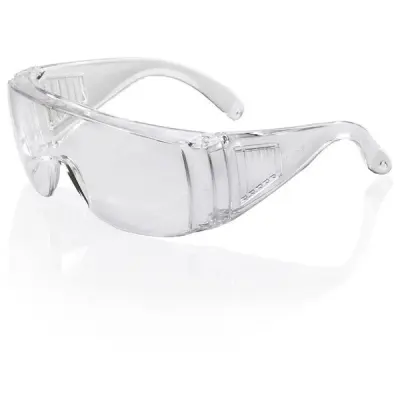
- General workshop and site work with flying particles: safety spectacles rated F, optical class 1.
- Grinding, chiselling and cutting: goggles rated B, or a face shield rated A worn over spectacles.
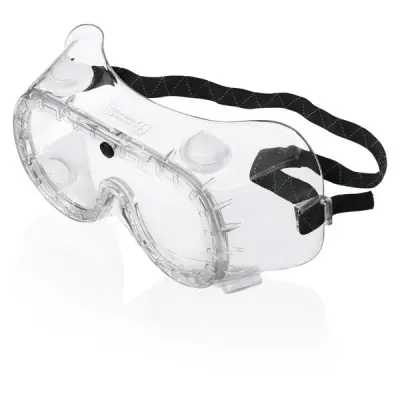
- Chemical splashes: goggles marked 3 — see our chemical goggles.
- Dust: goggles marked 4, or 5 for fine dust and gas.
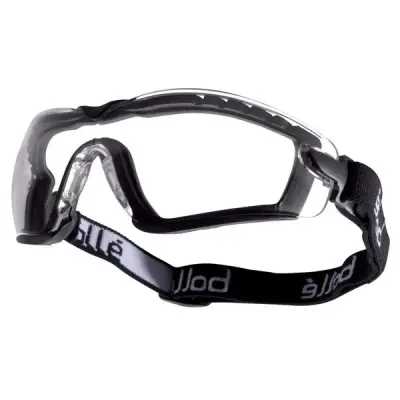
- Fogging is the usual reason people take eye protection off: look for N, or an anti-fog lens such as the Bollé Cobra.
- Prescription wearers: overspecs fit over normal glasses — look for the same markings on the overspec itself.
This is general guidance. Base your choice on your own risk assessment, and check the markings on the product itself — the lens and frame codes are what the protection is certified to.
Frequently asked questions
- What does F mean on safety glasses?
- F is the low-energy impact grade under EN 166: the eye protection stopped a 6 mm steel ball at 45 metres per second. It is the highest impact grade safety spectacles can carry.
- What is optical class 1?
- The best optical quality under EN 166, suitable for continuous all-day wear. Class 3 is for occasional use only.
- What do K and N mean on a lens?
- K means the lens resists scratching by fine particles. N means it resists fogging.
- Can safety spectacles be rated B?
- No. Under EN 166, spectacles can be rated S or F. Grade B needs goggles or a face shield, and grade A a face shield.
- What does T mean after the impact grade?
- The impact test was passed at extreme temperatures, from minus 5 to plus 55 degrees Celsius.