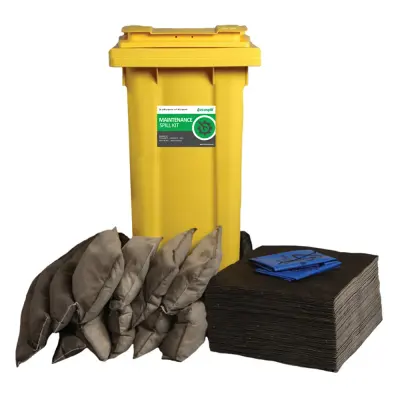
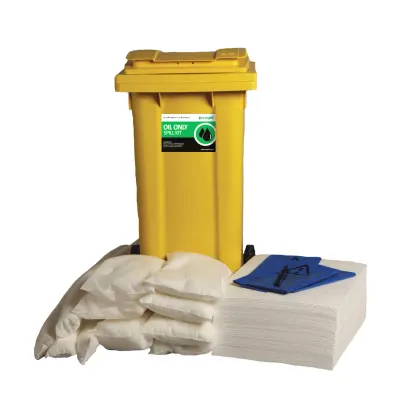
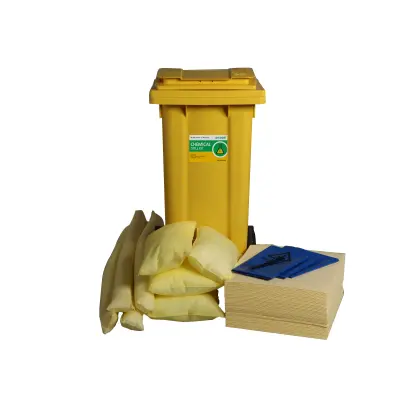
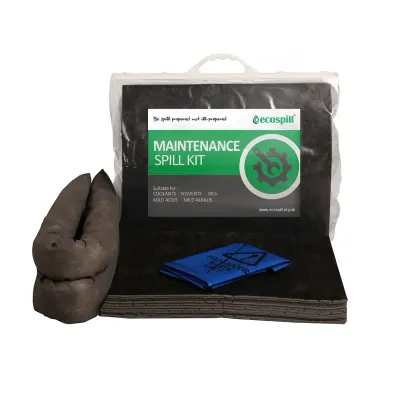
Spill kits are colour-coded so the right one gets used in a hurry. Grey is maintenance (general purpose), white is oil-only and yellow is chemical. Picking the wrong colour is not just wasteful: an oil-only absorbent will not pick up water-based liquids at all, and an ordinary absorbent on a strong acid can react with it. Start with what you store, then choose the format and the size.
Step 1: match the kit to the liquid
| Kit | Colour | Absorbs | Use it for | Do not use it for |
|---|---|---|---|---|
| Maintenance | Grey | Oil-based and water-based liquids | Workshops, plant rooms and factory floors: oils, coolants, lubricants, mild solvents, water, detergents | Strong acids and alkalis; spills outdoors in the rain or on water (it soaks up the water too) |
| Oil-only | White | Oils and fuels only; repels water | Fuel, diesel, hydraulic and engine oil, outdoors, in the rain, in yards and on water | Water-based liquids and chemicals |
| Chemical | Yellow | Almost any liquid, including aggressive ones | Acids, alkalis, labs, battery rooms, chemical stores, and any liquid you cannot identify | Spills on water: chemical absorbents are for use on land |
- Make a list of every liquid stored or used in each area, and check its safety data sheet. The data sheet tells you what will absorb it safely and what PPE to wear.
- If an area has a mix, a chemical kit covers the widest range. A maintenance kit is cheaper for the everyday oils and coolants that make up most workshop spills.
- Anything outdoors where rain or standing water is likely needs oil-only, because a grey or yellow absorbent fills up with water before it reaches the oil.
Step 2: pick the format for the spill
| Format | Best for |
|---|---|
| Socks | Ringing a spill to stop it spreading, and wrapping around machine bases and drums that drip |
| Pads | Soaking up a contained spill quickly, under drips and on work surfaces |
| Pillows | Larger volumes in a small footprint: sumps, bunds and drip trays |
| Rolls | Walkways and long runs of floor; cut to length |
| Loose granules | Rough or uneven floors, tarmac and thick, viscous spills |
| Drain mats and covers | Sealing a drain before a spill can reach it |
A spill on a slope or one still flowing needs containing first: lay socks in an overlapping ring, then recover the liquid inside with pads or pillows. A knocked-over container on a flat floor can go straight to pads, with socks around it if it is still spreading. Ready-made kits include a mix of socks, pads and pillows plus disposal bags, so you have the right format to hand.
Step 3: size the kit
- A kit’s litre size is roughly how much liquid it will absorb. Size it to the largest single container that could fail in that area: a 25-litre drum needs at least a 30-litre kit, a 205-litre drum a 240-litre kit.
- Where several containers are stored together, or a spill could involve more than one, add a second kit or a stock of top-ups.
- A 30-litre clip-top kit suits vans, forklifts and small workshops. A 120-litre wheeled bin suits a workshop bay or loading area, and a 240-litre bin suits a drum store or fuel point.
Where to keep it, and keeping it full
- Keep each kit close to where liquids are stored and used, in plain sight and clearly signed. If you cannot site one near every risk, choose a wheeled or portable kit that can get there quickly.
- Check the drain mats or covers in the kit are big enough for the drains on your site.
- A half-used kit is nearly as bad as no kit. Restock after every use; pads, socks and pillows are sold separately in each colour.
- Make sure the PPE for the worst liquid in the area is with the kit: gloves, goggles and, for chemicals, the protection the safety data sheet asks for.
Spill kits are only half the job: what you do in the first few minutes matters as much. See our 10-step spill response guide for the procedure and the law on oil storage.
Frequently asked questions
- What is the difference between a chemical and a maintenance spill kit?
- A maintenance kit (grey) absorbs oils, coolants and water-based liquids and is the general-purpose choice for workshops. A chemical kit (yellow) also handles aggressive liquids such as acids and alkalis, and is the safe choice when you cannot identify the liquid.
- Can I use an oil-only spill kit on water?
- Yes. Oil-only (white) absorbents repel water, so they pick up oil and fuel floating on water or lying in the rain without filling up with water.
- What size spill kit do I need?
- The litre size of a kit is roughly its absorbent capacity. Choose one at least as large as the biggest container that could leak in that area, and add extra kits or top-ups where several containers are stored together.
- What do the spill kit colours mean?
- Grey means maintenance (general purpose), white means oil-only and yellow means chemical. The colours let anyone on site pick the right absorbent quickly.
- Can a maintenance spill kit be used on acid?
- Not on strong acids or alkalis. Aggressive chemicals need a yellow chemical absorbent, because ordinary absorbents can react with them or break down.