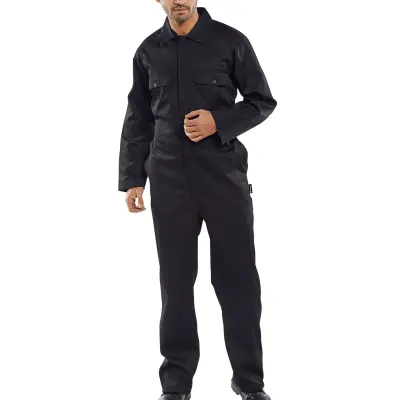
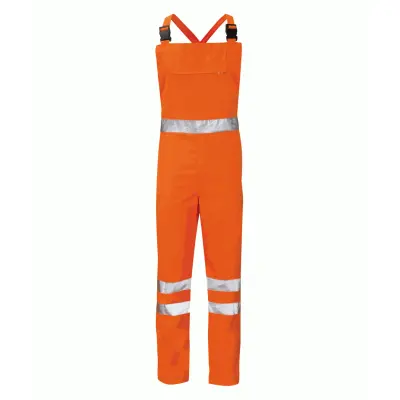
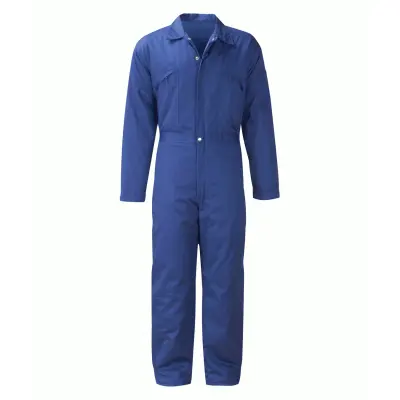
In the UK, “overalls” can mean two different garments, which is where most of the confusion comes from. A coverall (also called a boiler suit) is one piece that covers your arms, body and legs. Bib and brace overalls are trousers with a chest bib and shoulder straps, and leave your arms free. In the US, “overalls” almost always means bib and brace.
| Garment | What it covers | Best for | Watch out for |
|---|---|---|---|
| Coverall | Arms, body and legs in one piece, usually zip or stud front | Dirty, oily or dusty work where everything underneath must stay clean | Warm in summer; the whole suit comes off for a toilet break |
| Boiler suit | The same as a coverall: the traditional UK name, often polycotton with a stud front | Engineering, maintenance, mechanics and plant work | Pick a zip front if it goes on and off a lot |
| Bib and brace | Legs and chest, with shoulder straps; worn with your own top or jacket | Trades who kneel and bend, painters, farm and yard work | Arms and back are exposed; add a jacket in bad weather |
| Disposable coverall | Full body, often with a hood, made for one use | Asbestos, insulation, spraying and chemical work | Rated by Type, not a workwear garment; see the Types guide |
Coverall or bib and brace?
- Choose a coverall when dirt, oil or dust would get onto your clothes from above the waist too: mechanics, plant fitters, engineers and cleaning crews. Browse work coveralls, from a regular boiler suit to a padded coverall for winter.
- Choose bib and brace when you need your arms free and want to vary what you wear on top through the year: joiners, painters, groundworkers and farm work. The Alpha bib and brace is a hard-wearing everyday option.
- For roadside and rail work, both come in hi-vis. See hi-vis coveralls; the Class depends on how much fluorescent and reflective material the garment has.
- For hot work, welding or electrical risk, an ordinary coverall can burn or melt. You need a flame-retardant or arc-rated coverall instead.
Getting the fit right
Coveralls are sized by chest, and many come in short, regular and tall leg lengths. Go up a size if you will wear it over a jacket or thermal layer, or if you bend and kneel a lot: a tight coverall pulls at the shoulders and crotch. Look for knee-pad pockets if you kneel, and stud or zip sleeve cuffs to keep loose fabric away from moving parts.
Disposable coveralls are protective clothing, rated by Type (5/6, 4, 3) for dust, spray and chemicals. They are a different choice from workwear coveralls. See our disposable coverall types guide.
Frequently asked questions
- Is a boiler suit the same as a coverall?
- Yes. Boiler suit is the traditional UK name for a one-piece coverall, so the two words describe the same garment.
- What is the difference between coveralls and overalls?
- Coveralls are one piece and cover your arms as well as your body and legs. Overalls usually means bib and brace: trousers with a chest bib and straps that leave your arms free. In the UK, people sometimes call coveralls overalls too.
- Are bib and brace overalls better than coveralls?
- Neither is better overall. Bib and brace is cooler and lets you change what you wear on top; a coverall keeps everything underneath clean. Choose by how dirty the job is and how much you move.
- Do coveralls come in hi-vis?
- Yes. Hi-vis coveralls are made to EN ISO 20471, often Class 3, for roadside and rail work. Rail work needs orange to RIS-3279-TOM.
- Can I weld in a normal coverall?
- No. Ordinary polycotton or polyester coveralls can burn or melt. Welding and hot work need a flame-retardant coverall to EN ISO 11612 or EN ISO 11611.