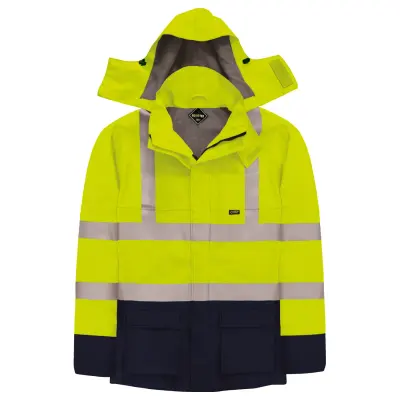
Short answer: if your team works outside in the rain for most of the shift, most of the year, GORE-TEX® Workwear is usually worth it. It stays waterproof without relying on a coating, and it lets sweat out, so people stay dry from the inside as well. If waterproofs only come out of the van a few times a month, a PU-coated or breathable waterproof is the better use of the budget.
Three ways to make a waterproof
- PU-coated. A polyurethane (or PVC) coating on the inside of the fabric keeps water out. It is cheap and properly waterproof, but the coating barely breathes, so anyone working hard gets wet from their own sweat. Coatings also crack and wear at the folds and seams with use and washing.
- Breathable coated or laminated. A more open coating or a basic membrane lets some water vapour through. It is more comfortable than PU for active work, at a moderate price.
- GORE-TEX® Product Technology. A GORE-TEX® membrane is laminated to the outer fabric. Its pores are too small for rain to get through but large enough for sweat vapour to escape. The seams are taped, and the garment is tested as a finished item.
How to compare them: EN 343
EN 343 gives every rainwear garment two numbers and, optionally, a letter. The first number is water penetration and the second is breathability, both from class 1 (lowest) to class 4 (highest). "R" means the finished garment passed a rain tower test. The breathability number is where the three types differ most. See EN 343 explained.
| PU-coated | Breathable | GORE-TEX® | |
|---|---|---|---|
| How it keeps rain out | Coating inside the fabric | More open coating or basic membrane | Membrane laminated to the fabric, taped seams |
| Typical EN 343 rating in our range (where stated) | 3:1 (breathability class 1) | 3:3 | 4:4:R (Hudson 3:3; PYRAD® 4:3:R) |
| Comfort for active work | Low: sweat builds up | Moderate | High: top breathability class |
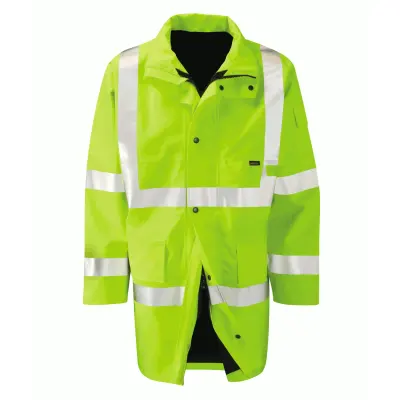
| Jackets in our range | £15.80–£53.23 | £19.58–£111.48 | £119.32–£146.95 |
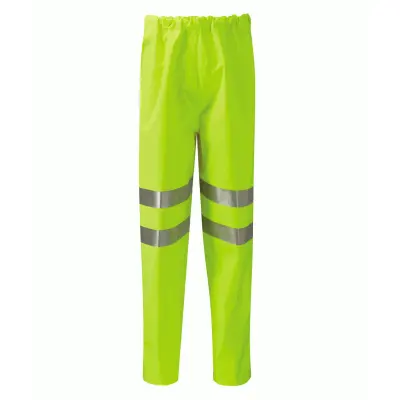
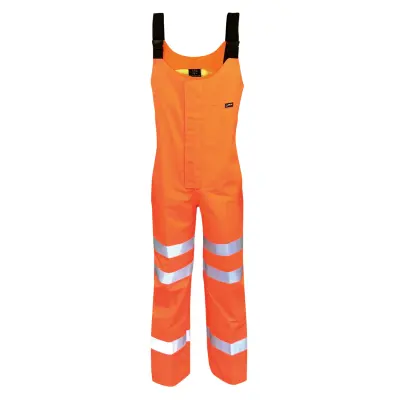
| Over trousers and salopettes | £7.95–£49.20 | £11.17–£63.25 | £78.12–£135.53 |
| Best for | Occasional showers, visitors, van kits | Regular outdoor work in moderate rain | All-day outdoor work in heavy rain |
Which to choose for which job
- Visitors, drivers and occasional use. A PU-coated waterproof kept in the van is enough.
- Regular outdoor work in mixed weather. Breathable waterproofs are the middle ground.
- All-day work in heavy rain, such as civils, highways, rail, utilities and marine. GORE-TEX® Workwear is the sensible choice. Rail teams need the RIS-3279-TOM certified orange garments.
- Electrical or flame risk. Standard waterproofs, including standard GORE-TEX® Garments, have no flame-retardant rating. Choose Arc Rated GORE-TEX® PYRAD® Garments such as the Velocity jacket.
Making it last
A GORE-TEX® Garment needs care to keep performing. The outer fabric’s water-repellent finish wears off with dirt and use, and it is restored by washing and warm tumble drying. See How to wash GORE-TEX® Workwear.
Frequently asked questions
- Is GORE-TEX® workwear really waterproof?
- The GORE-TEX® Garments in our range are rated EN 343 class 4 for water penetration, the highest class, and most are also rain tower tested (R).
- Why do people say waterproofs make them wet?
- Sweat. A PU-coated garment keeps rain out but traps the water vapour your body gives off, which condenses inside. Breathability (the second EN 343 number) measures how well a garment lets it out.
- Is GORE-TEX® workwear flame retardant?
- Standard GORE-TEX® Garments are not. Arc Rated GORE-TEX® PYRAD® Garments are, and they carry flame and arc-flash certifications.
- Can GORE-TEX® workwear be hi-vis?
- Yes. Most of our range is certified to EN ISO 20471 (Class 1, 2 or 3) as well as EN 343.